
Two Friends Reading

Our journeys in literature

Author: adityeah

  • An ode to “HUM”

    An ode to “HUM”

    I recently noticed that whenever I visit my workplace here in Melbourne (yes, I am still WFH mostly), the infamous “Jumma Chumma” song from the 90s ends up running in my head all day.

    It did not take me long to realise that the culprit here was the arrival chime of the lift (elevator) of the building. That chime sounds very similar to the very opening, the first 1 second of “Jumma Chumma”.

    Here’s the chime I recorded from the lift:

    Here’s the 1st second of the song:

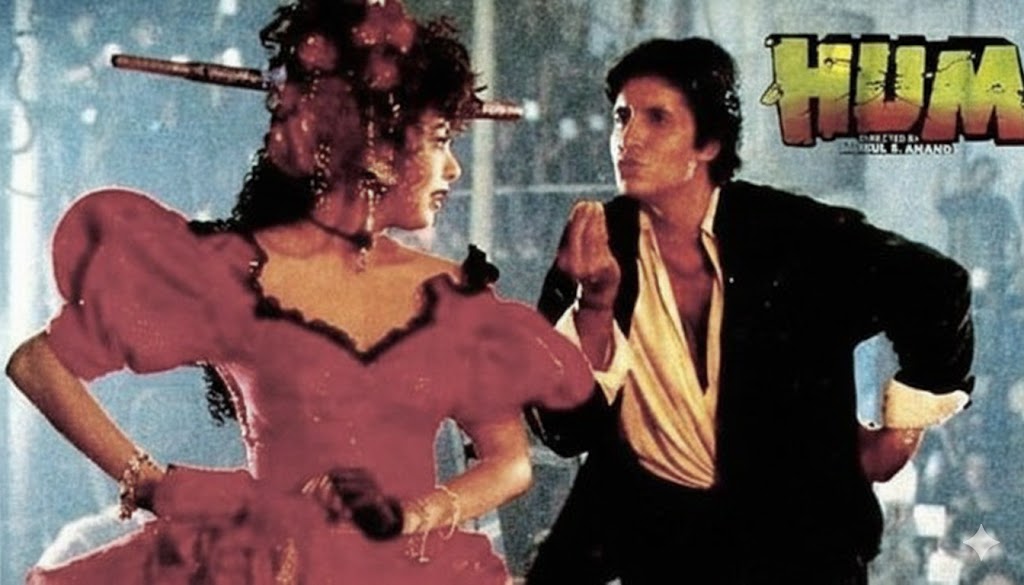
    When I think of it, it sounds amazing how a sound of an elevator chime, lasting merely a second, could evoke memories of a song from 35 years ago (“HUM”, the movie of the song, was released in 1991). But if you knew what a rage this song, and with that, this movie was back then, you’d probably understand.

    With Amitabh Bachchan’s powers on the wane (he was 49 in 1991), it must have been brave of Mukul Anand to imagine him playing the character of a dockyard worker in Bombay, assertively asking the lady for a kiss, with mugs of beers being banged in joyous chorus, by hundreds of men. The song begins with a close-up of Kimi Katkar lips, as she is applying lipstick (that’s when a series of dings happen, followed by the synthesiser)

    To put in context, the title of the song, translated, is unashamedly, “Jumma, give me a kiss”.

    Bachchan had never tried anything like this, in his entire career. In fact, the story goes, that the choreographer’s assistants refused to show the moves he was supposed to rehearse, for the fear that he’d be offended by the vulgarity in it. And they were right – Bachchan refused to do it; he had to be eventually convinced by his wife (and actress) Jaya to do it.

    But the song had Bachchan ingrained in it – it was sung by Sudesh Bhosle, who was (is) the closest ever voice artist to mimic Bachchan’s iconic voice.

    Eventually, this song became the quintessential anthem of the early 90s Bollywood. It was everywhere. And for a long time.

    It should be mentioned that the tune wasn’t an original. But it was the lyrics that broke through a threshold of assertiveness unknown at that time.

    The ensemble cast of Govinda, Rajinikanth, Deepa Sahi, Danny Denzongpa, Anupam Kher and Kader Khan, all stalwarts of Indian Cinema, added to the euphoria that was built up. My uncle who was studying in IIT Bombay then, once told me a story about how, when this movie released, there was a ruckus in one of the cinema halls where the tickets were sold out. They had to eventually allow everyone in and people sat squatting on the floor to watch this movie.

    It wasn’t that such a thing in Bollywood was not seen before – there had been many examples of such insanity – but it should be seen in the context of Bachchan’s sunset of super-stardom that was happening then. Bachchan had had a string of flops between 1989-1990. The late Mukul Anand, the director of the movie, must have held a very strong conviction to make it work despite those failures.

    The song ends on the same note on which it starts – and then you realise that the opening scene of the gleaming lips was actually an intended seed that was planted – because in the ending, it is all over Bachchan’s exclaimed face of happiness.

    Later, when we purchased a video player, we bought a video tape of “HUM”, simply because of the rewatchability of the movie.

    But with the office visits and the lift dings, I can assure you that rewatchability has extended some more..

  • Chapter 3 – The writing life

    Notes and observations:

    Beginning

    The chapter starts with a letter that Alex Chee wrote to Annie Dillard, when he applied for her literary non-fiction class at Wesleyan University (where he is eventually accepted).

    There’s some plenty of good writing advice in this chapter and the first one is revealed to us at the very beginning – when Dillard, in her first class, tells her students not to read her work while they were her students – she wanted them to not lose their individuality.

    This, and the other advice that Chee was influenced by greatly was:

    I can still hear her say it: Put all your deaths, accidents, and diseases up front, at the beginning. Where possible. “Where possible” was often her rejoinder. We were always to keep in mind that it might not be possible to follow rules or guidelines because of what the writing needed.

    This advice must have clearly left a mark because of the way the author describes it. Notice how he acknowledges Dillard’s lack of sternness for this advice.

    Heeding her advice, years later while writing this book, the author describes an “accident” at the beginning of the chapter itself, where he blends a story about falling asleep in a drawing class and then reprimanded to head home. He describes the teacher in a non-intimate yet, elegant way:

    She was an elegant, imperious woman with dark, short curly hair and a formal but warm manner, known for her paintings of clouds

    Cloud painter, and all. How very awesome.

    “Stealing” a story from a typewriter

    The author talks about an incident when he ended up writing a short story on a typewriter (that he was about to lend to a friend). That writing experience, something that lasted four hours, had a profound impact on him. Stitching together some events from his life, he made up a fictional account that he later finds out, is called “The consolations of the mask”. It is described as:

    Where you make a place that doesn’t exist in your own life for the life your life has no room for, the exiles of your memory.

    It is an interesting thought experiment. We all have such places in our mind. It could be raw thoughts that we tend to censor before they are even born, or our deepest fears. We can agree that all fiction must be born out of this.

    The author’s friend had asked the typewriter for applying to a class conducted by the famous essaying Phyllis Rose. The story that Chee wrote just prior to handing his friend the typewriter was selected, while his friend did not make it to the list. Chee thought that by writing that story, out of impulse perhaps, there was something from that typewriter that he had taken out. He felt so guilty about it that he had wanted to apologize.

    But it is not just his sensitivity that is on display here, there is also an honest modesty. Chee goes on to attend a few writing classes of the highest repute, was accepted at prestigious writing seminars, which he aced (”and won from her another of those mysterious A’s”). But despite all this happening, there was a sense of confusion and he puts it beautifully and then ends it with an ultimate tribute to teachers.

    I was someone who didn’t know how to find the path he was on, the one under his feet. This, it seems to me, is why we have teachers.

    In awe of a teacher

    Chee describes Annie Dillard in an almost romantic way – it is clear that he is in awe of her. The one sentence that gives that away so easily is when he describes the lipstick mark on a cigarette filter as a “crown”. (”Lipstick crowns the golden Marlboro filter”). The next few pages of the chapter are filled with anecdotes of Annie Dillard’s teaching and would serve as an education for any budding writer.

    There’s something about the analogies that Chee knits up. It is noteworthy how he describes getting writing feedback from Dillard:

    Getting pages back from her was like getting to the dance floor and seeing your favourite black shirt under the nightclub’s black light, all the hair and dust that was always there but invisible to you, now visible.

    There’s so much thoughtfulness on display there. Further, Chee finds more analogies in his learning on the campus:

    I felt I finally understood what I was doing – how I could make choices that made the work better or worse, line by line. After over a year of feeling lost, this new feeling was like when your foot finds ground in the dark water. Here, you think. Here I can push.

    Chee ends the chapter talking about another one of Annie’s advice to her students – to go to a bookstore and find the place in the bookshelf, where your books will go. It was a symbolic exercise, but nonetheless, an encouraging one – to put up a finger, make a little space between the books. Annie was asking Chee and the handful of her students to aim high – and aim high they did.

  • Introduction to analysis – Alex Chee – How to write an autobiographical novel

    We started reading Alex Chee’s “How to write an autobiographical novel” in April 2023. The book is a very personal account of Alex Chee’s life when he was coming to terms with many of his identities. Through these essays, Chee reveals his struggles as a gay person in the US of the 1980s, as a gay writer trying to make his mark and the AIDs crisis. He lays bare his vulnerabilities though his honest admissions, his struggles, his wins and his losses.

    Each chapter can be read as an independent essay, however, continuity helps – we read this book from the beginning to the end, in order.

    We made notes on every chapter but most of them were simply observations and at various junctures, they were just plain admiration for the author. Many chapters are broadly a narration of events so sometimes, there’s not much to analyse. But some of them have deeper connections within the events mentioned. Those chapters warranted a much deeper focus to read. As expected, such chapters provided ample material to analyse and we have collected our notes on such chapters, collated them together in a way that can be made sense and put them here.

    These analysis aren’t a guide, nor were they ever intended to be that. However, we are hopeful that these notes would further supplement the understanding of anyone who has read this magnificent book.

  • Hello world!

    Welcome to WordPress, Mahafreed. This blog that your friend aditya set up, it has been waiting for you. This could be your first post. Edit or delete it, then start writing!